What if you could stop up to 97% of the sun's heat gain without making your home look like a dark cave or a mirrored office building? You have likely noticed that the afternoon sun in Parkland or Coral Springs does more than just brighten your living room; it actively works against your air conditioner and fades your expensive hardwood floors. Selecting the right window tint for house windows is the most effective way to address these pains while maintaining your home's aesthetic. We all know that Florida living often feels like a constant battle against rising FPL bills and relentless UV exposure.
This guide will help you master the science of selecting high-performance films to slash your cooling bills by up to 30% and block 99% of harmful UV rays. As a trusted local authority with decades of experience in our community, we want to ensure your investment is protected by professional-grade durability and a reliable warranty. We will explore the latest 2026 ceramic film technologies and explain how to balance visible light transmission with heat rejection. You will also learn how to satisfy HOA requirements while keeping your views crystal clear.
Key Takeaways
- Learn why standard glass fails in the intense Florida sun and how a professional coating provides the protection your home deserves.
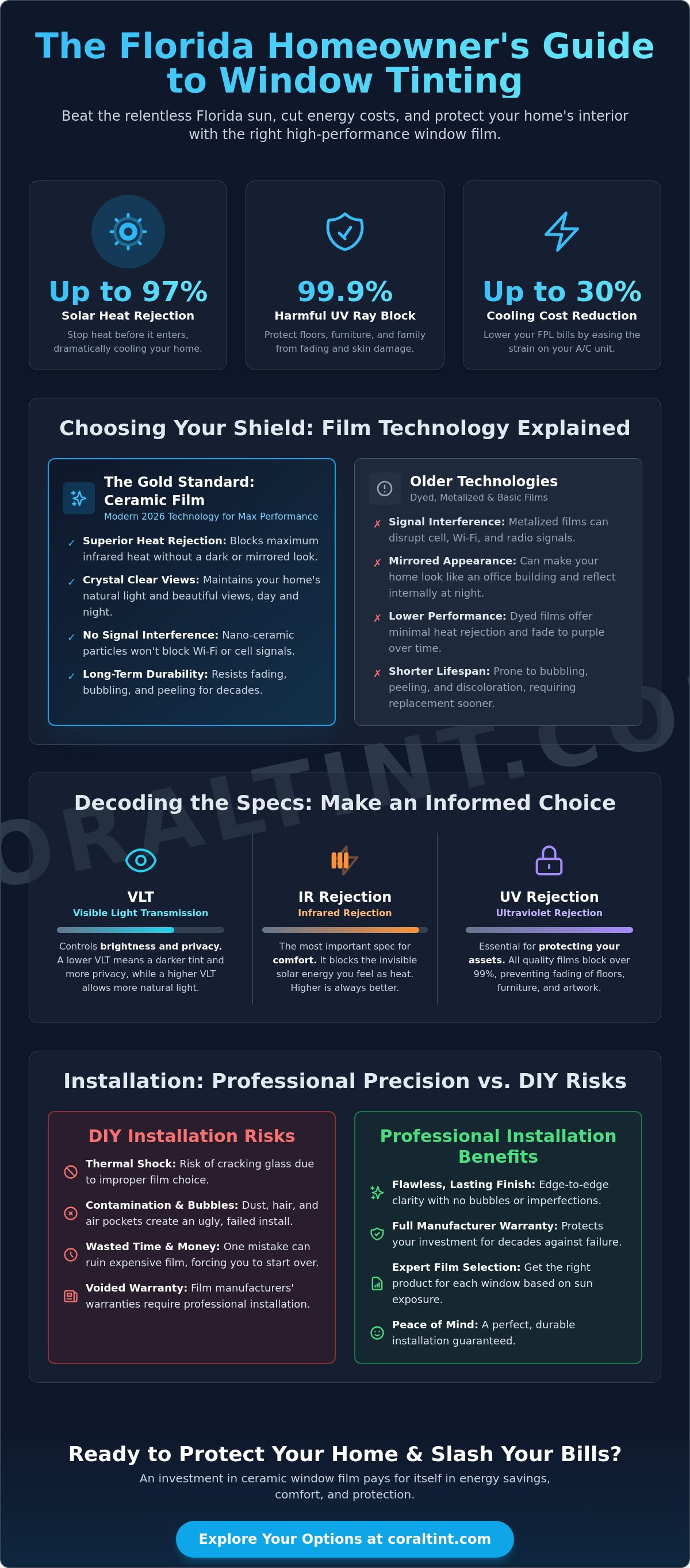
- Discover the difference between standard dyed films and advanced ceramic technology to ensure your window tint for house windows offers maximum heat rejection.
- Master technical specifications like VLT and IR blocking so you can select a film that balances room brightness with superior cooling performance.
- Follow a proven five-step audit of your home’s orientation to identify exactly which windows need the most protection from the afternoon heat.
- Understand the critical risks of DIY installation, including thermal shock, and why precision-fit edges are essential for a long-lasting warranty.
Why Install Window Tint for House Windows in South Florida?
Living in South Florida means dealing with a sun that never quits. Standard glass windows are essentially just holes in your thermal envelope, allowing heat and radiation to pour into your living space. This is the "Florida Factor." In cities like Coral Springs and Parkland, the intensity of the sun is significantly higher than in northern climates. Residential window tint is not a simple sticker; it is a high-performance window film made of polyester or ceramic layers designed to reject solar energy before it ever enters your home.
While the goal of heat rejection is shared with vehicles, residential film is engineered differently than what you receive from a car window tinting service. Automotive films are designed for curved glass and high-vibration environments. In contrast, residential films are thicker and utilize specialized mounting adhesives to handle the flat, expansive surfaces of house windows. This ensures the film remains stable and clear for decades without bubbling, peeling, or distorting your view of the neighborhood.
The Triple Threat: Heat, Glare, and UV Damage
Solar heat gain is a major drain on your finances. The U.S. Department of Energy reports that windows account for roughly 30% of residential cooling energy use. By installing window tint for house windows, you create a thermal barrier that reflects infrared heat. This acts as an invisible shield for your interior investments. In Parkland, homeowners often see their expensive hardwood floors and designer rugs fade within a few years due to UV exposure. High-quality professional films block 99% of these rays. Beyond protection, tinting eliminates the annoying glare on computer screens and televisions in your home office or media room, making your space more functional throughout the day.
Privacy and Curb Appeal Benefits
Privacy is a top priority for families in Coral Springs. You want to enjoy the view of your backyard or patio without feeling like neighbors can see every move you make. Daytime privacy films allow you to keep the blinds open while maintaining a clear view out. For entryways or bathrooms, decorative and frosted films offer a stylish alternative to heavy curtains or expensive glass replacements. These modern ceramic films protect your home without changing the outward appearance of your house. This helps you maintain the architectural integrity that your HOA requires while enjoying a cooler, more private home. If you are also exploring ways to enhance your windows with high-quality external treatments, you can learn more about QLD Shade and their range of premium awnings and shutters.
Understanding Your Options: Types of Residential Window Film
Choosing the right window tint for house windows requires looking beyond the price tag to understand the technology behind the film. While some big-box retailers promote basic dyed films or static-cling options, these often fail to deliver the long-term performance Florida homeowners need. Professional-grade films are sophisticated Energy Efficient Window Attachments that solve specific problems like heat gain and fading. Understanding the nuances of sunlight tint is the first step toward a more comfortable and efficient home.
Ceramic Window Film: The Gold Standard
Ceramic technology has revolutionized the industry by using non-conductive, nano-ceramic particles. Unlike older metalized films, ceramic options won't interfere with your Wi-Fi signals or cell reception. This is a critical factor for modern homes in Parkland where connectivity is essential. These films offer superior Infrared (IR) rejection, stopping the heat you feel without requiring a dark, cave-like appearance. You get maximum clarity and heat protection in one package. If you are looking for the best performance, you can explore our ceramic options to see the difference for yourself.
Reflective and Mirror Tints
Reflective films are excellent for heat rejection and daytime privacy. They work by creating a one-way mirror effect that prevents neighbors in Coral Springs from seeing inside during the day. However, standard reflective films can become mirrors on the inside at night, making it hard to see your pool or patio. Dual-reflective films solve this by having a different finish on each side, preserving your nighttime views while maintaining daytime seclusion. Be mindful that some HOAs have rules against "shiny" windows, so choosing a subtle bronze or charcoal reflective film is often the best way to balance efficiency with community standards.
For Broward business owners, specialty films provide more than just solar control. Security and safety films are designed to hold shattered glass together, providing an extra layer of protection against break-ins or accidental impacts. Anti-graffiti films are also a popular choice for commercial storefronts, as they can be easily replaced if the glass is tagged or scratched. Whether you need protection for your family or your business assets, there's a specialized film designed for your specific environment. Selecting a professional-grade window tint for house windows ensures that you aren't just darkening the glass, but actually improving the structural and thermal performance of your property.
How to Read Tint Specs: VLT, UV Rejection, and IR Blocking
Understanding the technical data behind window tint for house windows is essential for making a protected investment in your home. Many homeowners feel overwhelmed by the alphabet soup of industry acronyms, but these numbers are the only way to verify that a product will perform as promised. To grasp the science behind these coatings, you can consult Window Film Fundamentals, which explains how various materials interact with solar energy. When you look at a spec sheet, four primary metrics will dictate your comfort and savings.
- Visible Light Transmission (VLT): This refers to the percentage of visible light passing through the glass. A lower number means a darker tint.
- UV Rejection: You should demand a minimum of 99% UV rejection. This is the industry standard for preventing the irreversible fading of your furniture, artwork, and flooring.
- Infrared (IR) Rejection: This measures the film’s ability to block infrared radiation. Since IR is the primary source of the burning heat you feel on your skin, high IR rejection is non-negotiable for South Florida residents.
- Total Solar Energy Rejected (TSER): This is the most comprehensive number to watch. It combines VLT, UV, and IR metrics into one percentage that tells you exactly how much total solar energy the film stops from entering your home.
The VLT Sweet Spot for Homes
Finding the right balance of light is a personal choice, but a VLT between 35% and 50% is often perfect for Florida living rooms. It provides enough shade to reduce eye strain while keeping the space feeling open and bright. If you choose a film with a lower VLT, your home might feel too dark during those heavy rainy afternoons we frequently experience in Coral Springs. We typically recommend staying in this mid-range to maintain a natural aesthetic while still reaping the benefits of significant solar control. It keeps your home feeling like a home, not a dark theater.
Solar Heat Gain Coefficient (SHGC)
Your FPL energy bill is directly tied to the Solar Heat Gain Coefficient (SHGC). This metric measures the fraction of incident solar radiation that actually enters through the glass. Standard double-pane windows often have a high SHGC, meaning they act like a greenhouse by trapping heat inside. Professional residential window film installation optimizes these numbers by lowering the SHGC significantly. This simple upgrade can reduce your cooling costs by 20% to 30%, which adds up to substantial savings over the life of your home. By choosing a film with a low SHGC, you ensure your air conditioner doesn't have to work overtime just to combat the afternoon sun.
5 Steps to Choosing the Perfect Tint for Your Home
Choosing the right window tint for house windows is a process that requires more than just picking a color. It is a strategic decision that affects your home's comfort and energy efficiency for years. Unlike generic online kits that offer a one-size-fits-all approach, a professional selection process ensures that you address the specific challenges of your property. We have mastered this craft over several decades, and we recommend a logical, step-by-step evaluation before you commit to any installation.
- Step 1: Identify your primary goal. Are you trying to lower a high FPL bill, stop your neighbors in Parkland from seeing into your living room, or protect your expensive furniture from fading?
- Step 2: Audit your window orientation. South and West-facing glass will always require higher performance specs than North-facing windows.
- Step 3: Check your glass type compatibility. This is a critical safety step. Applying the wrong film to certain types of glass, like annealed or dual-pane windows, can lead to thermal shock and glass breakage.
- Step 4: Request physical samples. Seeing a film in a catalog is not the same as seeing it on your own glass in natural light.
- Step 5: Verify the warranty. Ensure you are working with a reputable window tint company near me that offers a manufacturer-backed guarantee.
Auditing Your Home’s Exposure
In South Florida, the sun does not hit every wall with the same intensity. South and West-facing windows are the primary culprits for heat gain because they receive direct solar radiation during the hottest parts of the day. You can perform a simple "heat test" by touching your glass at 2 PM. If it feels hot to the touch, your glass is absorbing energy and radiating it into your home. These specific windows require films with higher Total Solar Energy Rejected (TSER) ratings. You should also consider your exterior landscaping. A large oak tree might provide enough shade for a window to only need UV protection, while an exposed sliding door needs heavy-duty ceramic film.
Sample Testing and Visual Checks
Never commit to a film without seeing a physical sample in your home. Looking through a sample is entirely different than looking at a digital photo. Low-quality films often exhibit a "haze" or a blue or purple color shift when viewed at an angle. You need to check your samples against your specific interior lighting and the natural light at different times of the day. A film that looks great at noon might feel too dark during a typical Florida afternoon storm. Selecting the right window tint for house windows is much easier when you can compare the clarity of professional ceramic options against standard films side-by-side.
Ready to see these films in action? You can schedule a free home consultation to view our full range of professional samples and get an expert assessment of your glass.
Professional Installation vs. DIY: Protecting Your Investment
It is tempting to view a weekend DIY project as a way to save a few dollars, but installing window tint for house windows is a precise trade that requires specialized tools and years of practice. Unlike painting a wall where a mistake can be sanded away, an incorrect tint application can lead to permanent damage. Since 1987, our family has served the Coral Springs community, and we have seen firsthand how low-quality DIY kits fail under the intense Florida sun. Professional installation isn't just about the aesthetic finish; it is about protecting the structural integrity of your home's glass.
One of the most significant risks of an amateur installation is thermal shock. If you apply a film with high heat absorption to a window that isn't rated for it, the glass can expand unevenly and crack. Professional installers understand the science of glass compatibility and select films that won't compromise your windows. Beyond safety, an expert craftsman provides precision cutting and "gapless" edges that are virtually invisible. This level of detail prevents the unsightly bubbling and peeling that often appear on DIY projects within just a few months. When you choose an expert, you are investing in a result that looks like a factory finish rather than a temporary fix.
Warranty and Glass Breakage Protection
The difference between a 30-day Amazon return window and a professional lifetime manufacturer warranty is immense. Most high-performance residential films installed by experts include a comprehensive warranty that covers bubbling, peeling, and even glass breakage. This provides a level of peace of mind that a DIY kit simply cannot match. Professional installers carry full insurance for your home, ensuring that your property is protected during every step of the process. A transferrable residential warranty even adds value to your home if you decide to sell in the future, as the new owners will inherit the same protection and performance you enjoyed.
Getting a Precise Estimate
Preparing for your upgrade is simple when you know what to look for. Before you call for a tint quote, take a quick look at your windows to identify any existing seal failures or scratches. A local expert can spot these potential issues during a consultation, helping you avoid tinting a window that might need mechanical repair first. The long-term ROI of professional film is much higher than DIY options because you won't be paying to remove and replace failing film every two years. By choosing a partner with a multi-generational history in the region, you ensure that your investment in window tint for house windows is backed by a business that will be here to stand by its work for decades to come.
Secure Your Home’s Comfort and Efficiency Today
Choosing the right window tint for house windows is more than a home improvement project; it is a long-term investment in your family's comfort and your property's value. By understanding how to balance light transmission with heat rejection and following a strategic audit of your home's exposure, you can effectively neutralize the harsh Florida sun. We have seen how the right technology, specifically advanced ceramic films, preserves interior aesthetics while providing immediate relief from rising energy costs.
At Coral Tint, we have been serving the Coral Springs community since 1987. As an Authorized Ceramic Film Installer, we provide the technical precision and specialized application methods required to ensure your installation lasts a lifetime. Our work is backed by a Lifetime Residential Warranty, giving you the security of a multi-generational business that stands by its craftsmanship. Don't settle for temporary solutions that compromise your views or your safety.
Take the first step toward a cooler, more private home by reaching out to our team of seasoned experts. Get Your Free Residential Tint Quote from Coral Tint Today and experience the difference that professional authority and local warmth can make for your property. We look forward to helping you protect your home for years to come.
Frequently Asked Questions
Can window tint for house windows damage my glass?
Professional installation ensures your glass remains safe from damage. We carefully analyze your specific glass type, such as annealed or tempered units, to prevent thermal shock. This is a risk often associated with low-quality DIY films that absorb too much heat. Our expert team selects films that are engineered to match your window’s thermal expansion ratings perfectly.
Will tinting my home windows kill my indoor plants?
Your indoor plants will generally thrive with window film. Most plants require visible light for photosynthesis, which our high-performance films are designed to let through. By blocking 99% of harmful UV rays, the film actually protects your plants from "leaf burn" and prevents the soil from drying out too quickly in the intense Florida heat.
How long does professional residential window tint last?
You can expect a professional installation to last between 15 and 20 years or even longer. Because we use high-grade adhesives and advanced scratch-resistant coatings, the film won't bubble, peel, or discolor like cheaper retail alternatives. We back our residential projects with a lifetime warranty to give you total peace of mind for as long as you own your home.
Does window film provide privacy at night when the lights are on?
Standard window tint for house windows does not provide privacy at night when your interior lights are on. The privacy effect of solar film is based on light balance, meaning it is most effective on the side with the brightest light. If you require 24/7 privacy for a bathroom or entryway, we recommend our decorative or frosted film options which remain opaque regardless of lighting.
Can I clean my tinted windows with Windex or ammonia-based cleaners?
You should never use Windex or any cleaners containing ammonia on tinted glass. Ammonia is a harsh chemical that can eventually degrade the scratch-resistant coating and the adhesive bond. For the best results, use a soft microfiber cloth and a simple solution of mild dish soap and water. This gentle method keeps your windows crystal clear without compromising the film's integrity.
What is the best type of tint for blocking the most heat?
Ceramic film is the gold standard for heat rejection in South Florida. It utilizes nano-ceramic particles to block up to 97% of infrared radiation, which is the primary source of the heat you feel on your skin. This allows you to achieve maximum comfort without needing a dark or reflective appearance that might conflict with HOA rules or darken your interior too much.
How much can I expect to save on my energy bills with window film?
Most homeowners see a reduction of 20% to 30% in their monthly cooling costs after a professional installation. By blocking solar heat before it enters your home, the film reduces the load on your air conditioning system. This leads to immediate savings on your FPL bills and extends the lifespan of your HVAC equipment by reducing its daily run time.
Is it better to tint windows or use blackout curtains?
Tinting is significantly more effective at managing heat than blackout curtains. Curtains allow solar energy to pass through the glass and get trapped against the fabric, which still warms the room. Window film reflects that energy back outside before it can enter your living space. It also allows you to enjoy natural light and your view without the "closed-in" feeling of heavy drapes.