Did you know that your windows are responsible for up to 30% of your home's total heating and cooling energy consumption? It's a frustrating reality for many property owners who watch their electricity bills soar while expensive hardwood floors and upholstery slowly fade under the intense sun. We understand that feeling of exposure when large, clear windows compromise your privacy and leave you feeling vulnerable in your own space.
At Coral Tint, we believe your glass should do more than just let in light. Modern window film is no longer just a dark sticker; it's a high-tech performance skin designed to transform your home, office, or vehicle into a protected sanctuary. This 2026 guide will show you how to turn your glass into a high-performance barrier against heat, UV damage, and even intruders. We'll explore the latest nano-ceramic technologies that block 98% of infrared rays and explain how you can achieve 99% UV protection while maintaining a crystal-clear view. From lowering your cooling costs by up to 30% to enhancing your security, you'll learn exactly how to choose the right solution for your peace of mind.
Key Takeaways
- Understand how multi-layered polyester laminates manage the solar spectrum to shield your interiors from invisible heat and damage.
- Learn to decode performance metrics like VLT and TSER so you can select the ideal level of darkness and heat rejection for your space.
- Compare specialized types of window film, including solar control and security options, to address your specific comfort and safety priorities.
- Discover why professional installation techniques, such as precision computer cutting, are the only way to ensure a flawless, dust-free finish.
Understanding Window Film: More Than Just a Tint
Many people assume that window film is just a dark piece of plastic applied for privacy. In reality, modern window film is a sophisticated, multi-layered laminate of high-grade polyester engineered to enhance the performance of your existing glass. While the term "tinting" usually refers to the aesthetic color of the material, professional-grade film focuses on functional benefits like solar control, safety, and energy efficiency. You can find a comprehensive overview of window film that details its technical evolution, but for most property owners, it's simplest to think of it as a retrofitted glass upgrade that significantly boosts performance without the cost of replacement.
At Coral Tint, we've seen how this technology has evolved since we opened in 1995. We don't just "darken" windows; we install high-performance barriers. Ultimately, window film is a retrofitted glass upgrade designed to boost the performance and longevity of your windows without the disruption of total glass replacement.
The Anatomy of a High-Tech Film
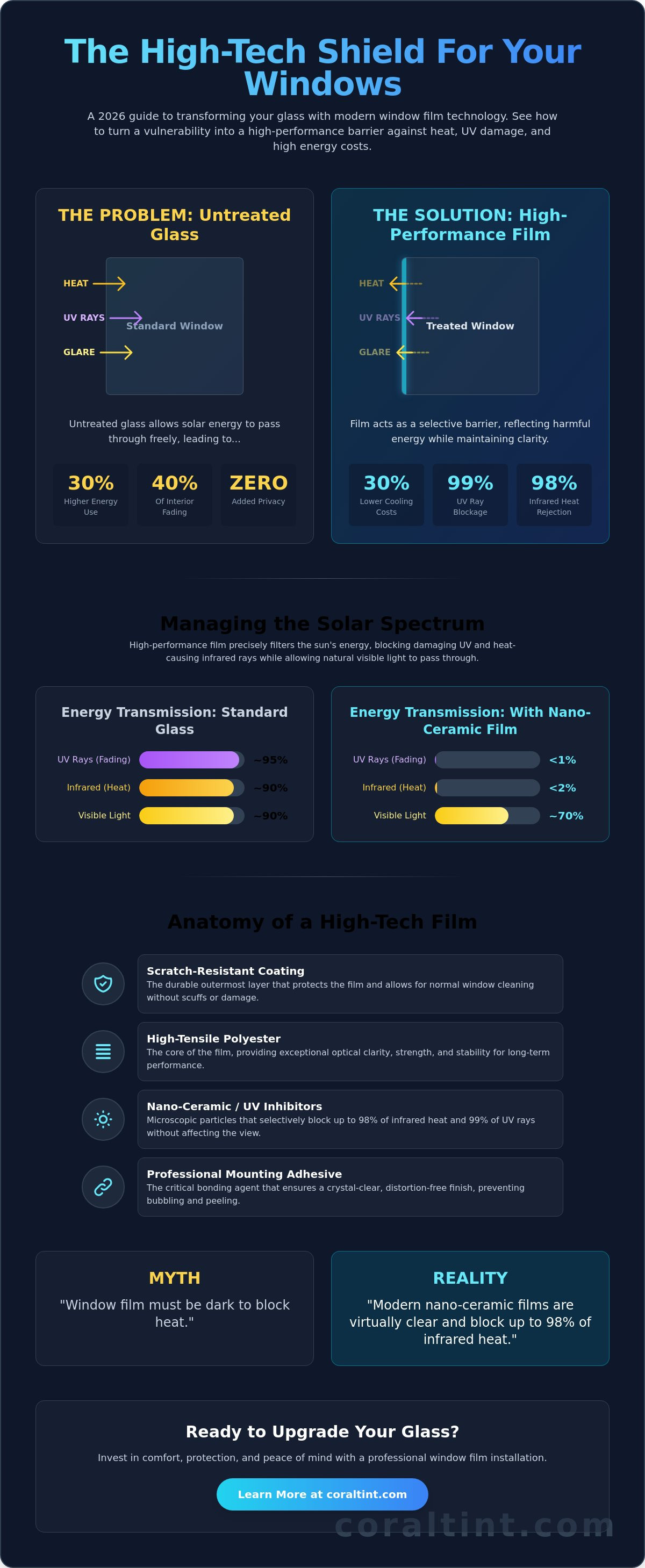
A high-quality film isn't just one sheet; it's a sandwich of specialized layers. The outermost layer is a scratch-resistant coating. This is vital because it allows you to clean your windows normally without worrying about scuffs. Beneath that, the core is made of high-tensile polyester, which provides clarity and strength. Finally, the mounting adhesive is what separates the experts from the amateurs. A professional-grade bond ensures the film remains perfectly clear and prevents the bubbling or peeling often seen in low-quality products. Our state-of-the-art computer cutting systems ensure these layers are trimmed with absolute precision for a seamless fit.
Why Glass Needs an Upgrade
Standard glass is essentially a hole in your building’s insulation. According to the U.S. Department of Energy, windows account for 25% to 30% of residential heating and cooling energy use. Glass alone can't block the invisible infrared rays that cause heat to build up indoors. Window film acts as a thermal barrier, reflecting heat away in the summer and helping to retain it in the winter. It also incorporates UV inhibitors that block 99% of harmful rays. This protects your health and prevents your expensive hardwood floors from fading over time. When you upgrade your glass, you aren't just changing the look; you're investing in long-term protection and peace of mind for your family or business.
The Science of Heat and UV Protection
Understanding the sun's energy is the first step toward reclaiming your indoor comfort. Solar radiation hits your glass in three distinct parts: ultraviolet (UV) rays, visible light, and infrared heat. While visible light allows us to see, infrared heat is the invisible culprit that turns your living room into an oven. Standard glass allows nearly all of this energy to pass through, forcing your HVAC system to work overtime. High-performance window film changes this dynamic by either reflecting or absorbing specific wavelengths of energy before they ever enter your home.
In South Florida, we deal with some of the highest UV indices in the country. This "Florida Factor" makes 99% UV rejection a non-negotiable standard for any installation we perform. Cheap, low-quality tints often absorb heat into the glass, which can lead to thermal stress or even cracks. In contrast, our professional-grade films are engineered to reflect heat away from the building. This reduction in solar heat gain significantly lowers the strain on your air conditioning. The U.S. Department of Energy highlights the effectiveness of Energy Efficient Window Attachments in reducing peak cooling loads, which leads to lower monthly utility bills and a longer lifespan for your HVAC equipment.
Stopping the Fade: Protecting Your Interior
UV radiation is responsible for roughly 40% of the fading seen on expensive hardwood floors, upholstery, and artwork. It's a slow but steady destruction of your property's value. The science behind our films involves multiple UV-absorbing layers embedded within the polyester laminate. These layers act as a permanent sunblock for your home. This is exactly why residential window film installation is such a critical investment for Florida homeowners who want to preserve their interior decor for decades.
Infrared Rejection vs. Visible Light
One of the biggest myths in our industry is that a film must be dark to block heat. Thanks to modern ceramic technology, this simply isn't true. Ceramic particles are small enough to let visible light pass through while specifically targeting and blocking up to 98% of infrared energy. This allows you to balance natural light levels with total thermal comfort. You can keep your beautiful views and clear windows while feeling the immediate difference in temperature. If you're tired of hot spots in your home or office, you can request a quote from our team to see which performance level fits your needs.
Types of Window Film: Choosing the Right Solution
Selecting the right window film isn't just about picking a shade; it's about matching a specific technology to your unique problem. Whether you're battling the intense glare in your home office or looking to fortify your business against potential break-ins, there's a specialized product designed for the task. You can explore a comprehensive overview of window film to see the vast array of materials available today, but most high-performance applications fall into four primary categories.
- Solar Control Films: These are the true workhorses of the industry, specifically engineered to cut glare and reduce the heat entering your space.
- Security and Safety Films: These films feature heavy-duty construction designed to hold glass together during impacts from storms or intruders.
- Decorative and Frosted Films: Perfect for bathrooms or glass partitions, these provide privacy and a custom aesthetic while still allowing natural light to flow through.
- Ceramic Films: As the premium choice for 2026, ceramic options offer the highest levels of infrared heat rejection without interfering with electronic signals.
Solar vs. Security: Which do you need?
While solar films focus on energy efficiency, security films are built for physical protection. A standard solar film is typically 2-mils thick, whereas a professional security film is usually 8-mils or thicker. This extra mass is what allows the film to hold glass shards together during a smash-and-grab attempt or a severe storm. Many of our clients choose a combination of both. By applying a solar-security hybrid, you get total property defense that keeps your interior cool while providing an invisible layer of armor against external threats.
Professional Grade vs. DIY Static Cling
It's tempting to look at a DIY static cling kit, but the performance gap is massive. Professional-grade films use advanced chemical adhesives that create a permanent, optically clear bond with the glass. This ensures the film won't bubble, peel, or turn purple after a few months in the sun. While a DIY product might only last 1 to 2 years before degrading, a professional installation from a trusted team like ours often carries a life expectancy of 15 years or more. Choosing DIY can also be a costly mistake; many window manufacturers will void your glass warranty if they detect a non-approved product has been applied. Since 1995, we've focused on providing peace of mind through precision and quality that temporary kits simply can't match.
Key Metrics for Selecting Your Film
Choosing the right window film requires looking past the shade of the material and focusing on the technical specifications that dictate performance. If you only look at how dark a film is, you might miss the metrics that actually keep your home cool and your energy bills low. We use data-driven performance charts to help our clients understand exactly what they are getting for their investment. Whether you're upgrading a coastal home or a local business, three primary metrics will define your experience: VLT, TSER, and U-Value.
- VLT (Visible Light Transmission): This is the percentage of visible light that passes through the glass. A lower number means a darker film, while a higher number allows more natural light to enter.
- TSER (Total Solar Energy Rejection): This is the single most important number for cooling. It measures the film's ability to reject the combined energy of UV rays, visible light, and infrared heat.
- U-Value: This measures heat transfer through the glass. While we focus on heat rejection in Florida, a lower U-Value helps retain your expensive air conditioning during the summer and keeps heat inside during our rare winter cold snaps.
- Glare Reduction: High-performance films can reduce glare by up to 90%, which is a game-changer for home offices where screen visibility is a constant struggle.
Visible Light Transmission (VLT) Explained
Finding the right VLT is a balance between privacy and visibility. If you have a room facing the intense afternoon sun, a lower VLT can soften the light and create a more comfortable environment. However, if you want to protect your view of the garden or the ocean, a high-VLT ceramic film offers 99% UV protection while remaining virtually invisible. It's also important to stay within legal limits for your vehicles. Our car window tinting service strictly follows Florida laws, which require at least 28% VLT on front side windows for sedans and SUVs alike. Understanding these percentages ensures your upgrade is both functional and compliant.
The TSER Advantage
Many customers mistakenly believe that a darker film always blocks more heat. This isn't true with modern technology. TSER is the true measure of cooling power because it accounts for the entire solar spectrum. For example, a premium ceramic film with a light 70% VLT can actually have a higher TSER than a cheap, dark 5% "limo tint" made of dyed polyester. This is because ceramic particles are specifically engineered to block infrared heat, which dyed films often let through. When comparing film tiers, always prioritize the TSER rating to ensure you're getting the maximum reduction in energy consumption. If you're ready to see how these metrics can lower your cooling costs, request a free quote and performance consultation today.
Professional Installation: The Coral Tint Difference
Achieving a flawless, factory-like finish on your glass requires more than just a steady hand. It demands a controlled, dust-free environment where every variable is managed. Even a single microscopic particle of dust trapped under the window film can create a permanent bubble or blemish. At Coral Tint, we've spent over 30 years refining our installation process to ensure that the final result is virtually indistinguishable from the glass itself. This level of precision is why we've been voted the best in the community for eight consecutive years by Our City News.
Technology plays a massive role in our success. While some shops still rely on hand-cutting material directly on your windows, we utilize state-of-the-art computer cutting systems. This ensures that every piece of film is trimmed to the exact specifications of your glass with digital accuracy. There's no risk of razor blades touching your glass or leaving jagged, uneven edges. This modern approach, combined with our deep roots in Coral Springs since 1995, allows us to offer a national lifetime product warranty that gives you ultimate peace of mind.
Why DIY Often Fails in South Florida
The intense South Florida climate presents unique challenges that most DIY kits simply can't handle. High humidity and extreme heat significantly impact the curing process of the film's adhesive. Without professional-grade tools and climate-controlled settings, DIY projects frequently suffer from contamination, creasing, and light gaps along the edges. These errors aren't just aesthetic; they can lead to premature peeling and failure. When you consider the cost of the kit plus the time spent on a failed attempt, the cost-benefit analysis clearly favors doing it right the first time with a professional team. We've seen many property owners spend more fixing a bad DIY job than they would have on a professional installation.
Expert Solutions for Every Environment
Our expertise spans across all glass surfaces, including Auto, Residential, Commercial, and Marine applications. Each environment has its own set of demands. For instance, saltwater exposure and constant UV reflection require the specialized durability found in marine window tinting. We use specific ceramic formulations that resist salt-air corrosion while providing maximum heat rejection. Whether you're protecting your family at home or your crew on the water, we provide a seamless experience from the first call to the final inspection. Ready to upgrade your glass? Get a professional tint quote today and see why our customers rave about the Coral Tint difference.
Take Control of Your Comfort and Privacy Today
Your glass shouldn't be a vulnerability in the face of the Florida sun. By upgrading with high-performance window film, you're choosing to lower your cooling costs, protect your health with 99% UV rejection, and secure your interior from prying eyes. You now understand that the difference between a temporary tint and a lifetime solution lies in the precision of the installation and the quality of the ceramic layers. Professional expertise ensures that your view remains crystal clear and your investment stays bubble-free for decades.
We've been serving our neighbors as a family-owned and locally operated business since 1987. Our commitment to excellence is why our team has been voted best by Our City News for eight consecutive years. We combine state-of-the-art technology with a personal, neighborly touch to give you total peace of mind. Every project we complete is backed by a national lifetime product warranty; you can trust that your property is in the hands of seasoned experts. Upgrade your property with Coral Tint—Call or Text us for a quote! We look forward to helping you transform your space into a cooler, safer sanctuary.
Frequently Asked Questions
How long does window film usually last?
Professional window film typically lasts between 15 and 20 years when installed by seasoned experts. Our high-performance products are backed by a national lifetime warranty, so you won't have to worry about the material failing or bubbling over time. The actual longevity depends on the specific film type and its exposure to the sun, but high-quality ceramic options are built for the long haul.
Can window film be removed if I change my mind?
Yes, it's fully possible to remove the film safely at any time without causing any damage to the underlying glass. We use professional-grade steamers and specialized adhesive removers to ensure the surface is perfectly clean and free of residue afterward. This flexibility is a great benefit for commercial tenants who may need to return a space to its original condition at the end of a lease.
Does window film cause glass to crack or break?
Modern window film does not cause glass to break when the correct product is matched to the specific glass type. We always perform a thorough glass-to-film compatibility analysis before every installation to prevent issues. This process ensures that the film won't cause thermal stress, which can sometimes occur if an improper film is applied to certain dual-pane or tinted glass surfaces.
Will window film affect my indoor plants?
Most indoor plants actually thrive after installation because the film filters out the intense UV rays that can scorch delicate leaves. While the film blocks 99% of UV radiation and significant infrared heat, it still allows the visible light necessary for photosynthesis to pass through. Your plants will likely enjoy the more stable, cooler indoor temperature provided by the upgrade.
How do I clean my windows once the film is installed?
You should wait at least 30 days for the curing process to finish, then use a soft cloth or squeegee with a non-ammonia cleaner. Avoid using abrasive pads or harsh chemicals that could damage the scratch-resistant coating. Simple mild soapy water is often the best and safest choice for maintaining that crystal-clear finish for years to come.
Is window film the same as window tint?
While people often use the terms interchangeably, "tint" usually refers to the visible color, whereas "film" describes the multi-layered performance technology. A high-tech film can be virtually clear but block significantly more heat than a standard dark tint. We focus on performance layers that offer solar control and security rather than just changing the aesthetic shade of the glass.
Can window film help with hurricane protection?
Security and safety films are specifically designed to hold shattered glass shards together during an impact. While these 8-mil or thicker films aren't a legal replacement for hurricane shutters, they provide a vital secondary defense against flying debris. This extra layer of protection can prevent wind and rain from entering your home if a window is struck during a severe storm.
How long does the film take to fully cure after installation?
The curing process typically takes between 30 and 60 days depending on the humidity and sun exposure in Coral Springs. During this time, you might notice small water bubbles or a slightly cloudy appearance. Don't worry, as these are a normal part of the evaporation process and will disappear completely once the adhesive bond is fully set.