ultimate-guide
Automotive Window Tinting Customization Options Explained
Last Updated: October 29, 2026
Quick Summary
Automotive window tinting customization spans five film types (dyed, metalized, hybrid, carbon, ceramic), VLT shade percentages, base tones, gloss or matte finishes, decorative vinyl and printed graphics, and switchable electric film that changes VLT on demand. Match film type and shade to how you use the car, not just how dark you want it to look.
- Ceramic film targets infrared heat and stays signal-friendly without relying on darkness.
- VLT measures visible light passing through film; lower numbers mean darker glass and less night visibility.
- Matte carbon film hides smudges and reads as factory-tinted glass on light-colored cars.
- Switchable film runs well above conventional ceramic film and adds wiring and service complexity.
- Coral Tint has served South Florida since 1995 with same-day tinting and a nationwide lifetime warranty.
Table of Contents
- Why Customization Matters More Than Picking the Darkest Film
- Types of Car Window Tint: Dyed, Metalized, Hybrid, Carbon, and Ceramic
- Car Window Tint Shades and How VLT Changes Visibility
- The Best Window Tint for Heat Rejection and Cabin Comfort
- Color, Finish, and Decorative Options That Change the Look
- Electric Window Tint for Cars: How Switchable Film Works
- Legal Limits, Installation, and What Affects Film Lifespan
- Request a Quote from Coral Tint for Your Vehicle
- Frequently Asked Questions
Why Customization Matters More Than Picking the Darkest Film
The U.S. automotive tinting film market was valued at $8.1 billion in 2025 and is projected to reach $8.7 billion in 2026, according to Grand View Research's automotive tinting film market report. That growth reflects a simple shift: drivers no longer treat tint as a single shade decision. Automotive window tinting customization options now span film chemistry, shade, color, finish, and even switchable glass, and picking the darkest roll on the shelf is the fastest way to end up with a car you can't see out of.
Coral Tint has served South Florida since 1995, and we recommend choosing film type and shade to match how you use the car, not just how dark you want it to look.
Below, we break down every customization lever, from dyed film to electric tint, so you can build a spec that fits your vehicle, climate, and state's rules.
Types of Car Window Tint: Dyed, Metalized, Hybrid, Carbon, and Ceramic
The five main types of car window tint differ in how they reject heat and how long they hold their color. Dyed film is the entry-level option: a pigment layer that absorbs solar energy and darkens the glass. It's affordable, but it absorbs rather than reflects heat and can fade or turn purple.
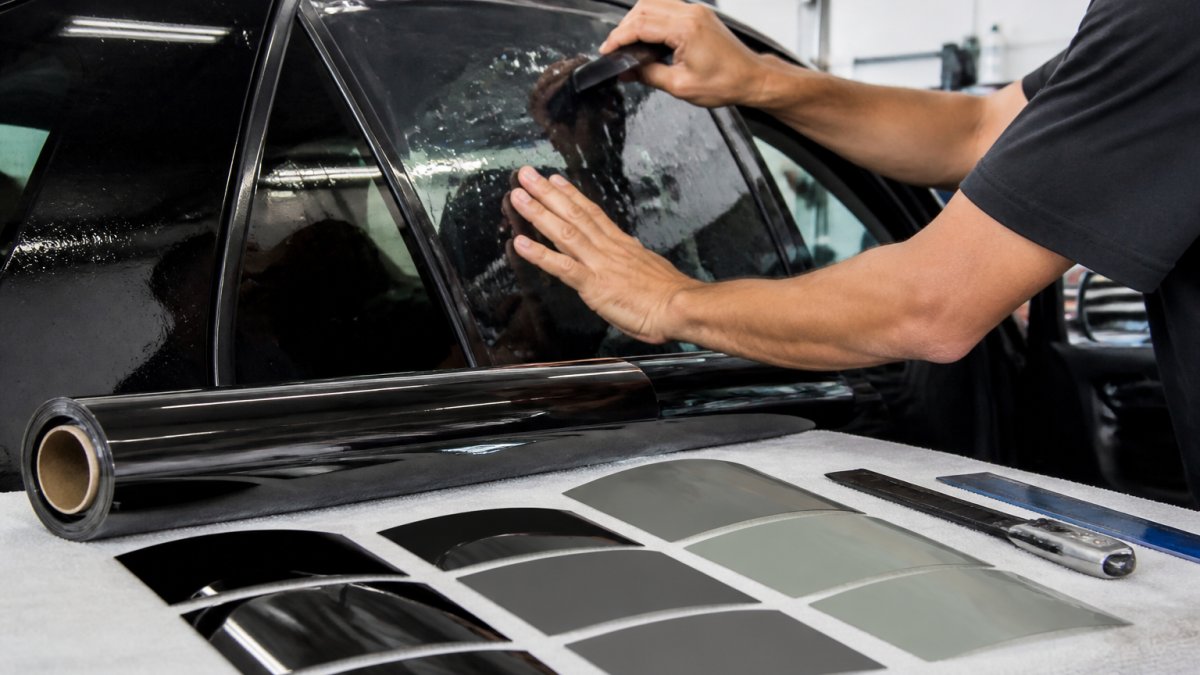
Metalized film adds a thin metallic layer that reflects infrared energy, improving heat rejection. The tradeoff is potential interference with GPS, cell, and radio signals in older or densely layered films.
Hybrid film combines dyed and metalized layers to balance cost and performance. For a broader guide to choosing the right tint film for your vehicle, see how to choose window tint film for your car, home or boat.
| Film Type | Heat Rejection | Signal Interference | Color Stability | Best For |
|---|---|---|---|---|
| Dyed | Low (absorbs) | None | Fades over time | Budget builds, mild climates |
| Metalized | High (reflects) | Possible | Good | Strong heat rejection on a budget |
| Hybrid | Moderate | Low | Good | Balanced cost and performance |
| Carbon | Moderate-high | None | Excellent | Matte look, long-term durability |
| Ceramic | Highest | None | Excellent | Hot climates, premium performance |
Car Window Tint Shades and How VLT Changes Visibility
Car window tint shades are measured by visible light transmission, or VLT: the percentage of visible light that passes through the film.
VLT is the number that matters legally and practically. Most states cap how dark front side windows can go, written in VLT percentages.
Our practical rule: match VLT to your driving conditions. If you do a lot of night driving or live where winter days are short, going below 20% on front windows gets uncomfortable fast.
The Best Window Tint for Heat Rejection and Cabin Comfort
Ceramic film is generally considered a strong option for heat rejection, because it targets infrared energy, the part of sunlight that carries the most heat, without relying on darkness. Readers in hot climates can find guidance on choosing the best window tint for Florida heat.
A common assumption is that darker film is always cooler, but heat rejection depends on the film's construction as well as its shade.
Color, Finish, and Decorative Options That Change the Look
Color and finish are where customization stops being a spec sheet and starts being a design decision. Two cars with the same VLT can look completely different depending on base tone, surface finish, and decorative work.
Base film tones
Automotive film is commonly available in a small set of tones:
- Charcoal / black, the default. Reads as neutral dark gray and pairs with almost any paint color. Most ceramic and carbon films land here.
- Smoke / gray, a softer, cooler tone that looks lighter than its VLT suggests. Popular on lighter vehicles where pure black looks heavy.
- Bronze / brown, a warmer tone that flatters beige, tan, gold, and certain red and green paints. Less common, so availability varies.
A practical rule: hold a film sample against the vehicle's glass in daylight before committing. Film tone shifts with the glass's own tint and the interior color visible through it.
Gloss versus matte finish
Finish is a function of film construction more than a separate choice:
- Gloss / reflective, typical of metalized film. The metallic layer gives the glass a mirror-like sheen. Looks premium on dark paints but can look busy on light ones.
- Matte / flat, typical of carbon film. Carbon particles scatter light rather than reflecting it, producing a flat look that hides smudges and reads as factory-tinted glass.
- Satin, a middle ground some hybrid films approach, with a soft sheen rather than a hard reflection.
If you want the glass to disappear into the car's design, matte carbon is usually the answer. If you want the tint to be a visible feature, gloss metalized delivers more presence.
Decorative and graphic film
Decorative work turns the glass into a canvas. Common categories include:
- Cut vinyl graphics, flames, stripes, skulls, geometric patterns, and club or business logos cut from colored vinyl and applied over or under the tint.
- Printed film, full-color graphics printed onto optically clear film, used for branding, event vehicles, and show cars.
- Accent films, chrome, brushed metal, and colored mirror films used on specific panels rather than whole windows.
Decorative film is usually applied to rear quarter glass, back glass, or a sun strip along the top of the windshield rather than full front side windows, because graphics on the driver's primary sight lines draw attention from law enforcement and can run into the same VLT and obstruction rules as dark film.
Matching color and finish to the vehicle
A simple decision path:
- Dark paint, clean look, charcoal ceramic in gloss or matte; the film disappears into the paint.
- Light paint, clean look, smoke or gray carbon in matte; pure black can look heavy against white or silver.
- Warm paint (beige, tan, gold, some reds), bronze film if the line offers it; charcoal otherwise.
- Show or brand vehicle, printed or cut vinyl graphics on rear and quarter glass, with conventional film on the front doors.
- Fleet or business vehicle, frosted or etched-look film for a subtle logo band that stays within legal VLT on driver's windows.
The goal is a spec where film type, shade, color, and finish all point the same direction. A matte carbon film in a smoke tone on a light-colored car reads as intentional; the same film in gloss reads as an afterthought. Cohesive aesthetics extend beyond the glass, as a well-executed cabin environment complements the exterior treatment through meticulous car interior detailing.
Electric Window Tint for Cars: How Switchable Film Works
Electric tint, also called switchable or smart film, is the only customization option that changes VLT on demand. Instead of picking a fixed shade, the driver toggles the glass between clear and tinted states. It is the most flexible option on the market and the most complex to own.
The main switchable technologies
Three technologies dominate automotive and architectural switchable glass:
- PDLC (polymer-dispersed liquid crystal), liquid crystal droplets suspended in a polymer film. With power applied, the crystals align and the glass looks clear; with power off, they scatter light and the panel frosts. PDLC controls privacy and glare but does not reject much heat on its own.
- SPD (suspended particle device), rod-shaped particles suspended in a film. Voltage aligns the particles to let light through; removing voltage lets them scatter and darken the panel. SPD delivers true variable tint rather than a clear-to-frosted switch, and is the technology most often used when adjustable darkness is the goal.
- Electrochromic, an electrochemical layer that darkens when voltage is applied and stays dark until reversed. Common on high-end vehicles as a factory option and closest to a true dimmable window, but aftermarket retrofit is limited.
What the driver actually controls
A switchable film system typically includes:
- The film itself, laminated to or applied on the glass
- A wiring harness routed through the door or window frame
- A control switch, remote, or app interface
Most systems offer at least clear and tinted states, and some SPD systems offer intermediate settings. Response time is typically a few seconds, and the tinted state is usually a fixed level rather than a continuous dimmer.
Performance and ownership trade-offs
Switchable film is not a substitute for ceramic film on heat rejection. PDLC controls privacy and glare far better than solar heat, so a vehicle in a hot climate often still benefits from ceramic film on non-switchable windows. SPD and electrochromic systems reject more heat but at a higher price.
The ownership considerations are real:
- Cost, switchable film runs well above conventional ceramic film, and the gap widens with the number of windows and control features.
- Complexity, wiring, a control interface, and a power source add failure points a passive film does not have.
- Service, not every tint shop installs or services switchable film, so warranty work may mean a longer drive or a return to the original installer.
Who it makes sense for
Switchable film is generally suited to a narrow set of buyers: show and luxury vehicles where the feature is part of the experience, vehicles used for privacy-sensitive work, and owners who want to switch between clear and tinted glass for night driving and daytime parking. For most daily drivers, a ceramic film in a legal shade remains the better value.
Legal Limits, Installation, and What Affects Film Lifespan
Legal limits vary by state and are typically enforced in VLT percentages on specific windows. Verify current rules with your state's motor vehicle department directly before you buy.
Installation quality drives lifespan as much as film quality. A clean, dust-free application with proper squeegeeing prevents the peeling and bubbling that plague cheap jobs. Durability also depends on sun exposure, film type, and glass condition; dyed films fade faster, while ceramic and carbon films hold up longer.
A PubMed-indexed study by LaMotte and colleagues examined tint levels associated with significant reductions in driver vision, a useful reminder that visibility should factor into your shade choice, not just style. For a full breakdown of how long film lasts and what shortens its life, read our guide on how long window tinting lasts.
Request a Quote from Coral Tint for Your Vehicle
Customization only pays off when the film is installed correctly and matched to your vehicle and your state's rules.
Coral Tint has served South Florida since 1995 as a family-owned, locally operated shop.
Get started with Coral Tint and build a tint spec that fits your car, your climate, and your budget. Learn how to book professional window tinting. Request a quote for your vehicle today.
Frequently Asked Questions
What are the different types of car window tint?
The main types are dyed, metalized, hybrid, carbon, and ceramic film. Dyed film is the least expensive and offers basic privacy, while metalized film uses metallic particles for added heat rejection. Hybrid film combines dyed and metalized layers. Carbon film blocks heat without metal, so it avoids signal interference. Ceramic film, including nano-ceramic, delivers the strongest infrared rejection and color stability, which is why it costs more. Each category changes how much heat, glare, and UV the film blocks.
What are the best window tint shades for balancing privacy and visibility?
Shade choice comes down to visible light transmission, or VLT. A 5% film is very dark and limits night visibility, while 35% and 50% films let more light through and are easier to see out of after dark. Pick a shade you can see through at night. Many owners use darker film on rear side windows and lighter film on the front.
Is ceramic window tint worth the extra cost over carbon or dyed film?
Ceramic film is generally priced above dyed or carbon film, and it is generally associated with infrared rejection and color stability over time. If your main goal is the best window tint for heat rejection, ceramic is the film to compare against. Carbon film blocks heat well without metal and avoids signal interference, so it suits drivers who want solid performance at a lower price. Dyed film is the budget option but fades faster and rejects less heat. Weigh the upfront price against how long you plan to keep the car.
Does electric window tint work on cars?
Yes. Switchable electric window tint is a category of film that uses technology such as PDLC (polymer-dispersed liquid crystal) so the glass can change between clear and tinted states. It gives you privacy on demand and lets you keep full visibility when you want it. The tradeoffs are higher cost and more complex installation than conventional film. For most drivers, a quality ceramic film covers heat and privacy needs at a lower price, while switchable tint suits owners who want adjustable privacy and are willing to pay for it.
The hardest part of automotive window tinting customization isn't choosing a film. It's knowing which combination of type, shade, and finish actually fits your car and your state's rules. Coral Tint removes the guesswork with precision-cut films, same-day installation, and a nationwide lifetime warranty, backed by nearly three decades of local experience. Get started with Coral Tint and request a quote for your vehicle.