 ultimate-guide
Do Commercial Energy Efficiency Solutions Cut Costs?
Last Updated: October 31, 2026
Quick Summary
Commercial energy efficiency solutions cut operating costs when you sequence them by payback rather than by how impressive they sound in a proposal. Start with an energy audit, then fund fast-payback lighting and controls, reduce solar load with window film, and replace HVAC equipment last, right-sized to the reduced load.
- An audit that never models peak afternoon solar load can misdiagnose unshaded glass as an HVAC problem.
- LED retrofits cut lighting energy and reduce cooling load because lamps convert less electricity to heat.
- Demand-controlled ventilation using CO2 sensors is often the largest HVAC control saving in intermittently occupied spaces.
- Economizers fail silently, so functional testing belongs in any commissioning scope.
- Submeter the affected circuit because whole-building utility data cannot isolate a single measure.
Table of Contents
- Where Commercial Building Energy Efficiency Solutions Actually Pay Off
- Start With a Commercial Building Energy Audit
- Energy-Efficient Lighting for Commercial Buildings: The Fastest Payback
- Commercial HVAC Energy Efficiency and the Load You Can Remove
- Commercial Window Film Energy Savings on Glass-Heavy Buildings
- Benchmarking, Measurement and Verification, and What to Ignore
- Sequencing the Work: A Prioritized Roadmap and Payback Order
- Request a Commercial Window Film Assessment
- Frequently Asked Questions
Where Commercial Building Energy Efficiency Solutions Actually Pay Off
Most commercial energy efficiency upgrades fail the same way: the owner approves a package of measures, spends the capital, and never learns which line item actually moved the meter. According to Lawrence Berkeley National Laboratory's case studies of energy information system use, the enterprises and university campuses that got real value from energy data treated it as an operating discipline, not a one-time purchase.
Commercial window film is one of the measures that can be sequenced into an efficiency plan, and buildings often chase savings in the wrong order.

Start With a Commercial Building Energy Audit
A commercial building energy audit is a systematic review of how a facility consumes electricity and fuel, where that consumption is wasted, and which fixes produce the fastest return. It gives you a baseline before you spend a dollar.
What an Audit Measures and What It Misses
An audit measures consumption by system: lighting, HVAC, plug loads, envelope losses. It also benchmarks your building against peers. What it often misses is how the building behaves across a full season, which is exactly where glass-heavy buildings get misdiagnosed.
Watch out: an audit that never models peak afternoon solar load will recommend HVAC work when the real problem is unshaded glass. Ask whether the report separates envelope gains from internal loads.
Energy-Efficient Lighting for Commercial Buildings: The Fastest Payback
Energy-efficient lighting for commercial buildings is usually the first measure to fund, because LED retrofits cut lighting energy sharply and often reduce cooling load at the same time.
The American Council for an Energy-Efficient Economy's commercial building efficiency work groups lighting alongside HVAC retrofits and demand flexibility as core efficiency territory.
A common mistake is retrofitting lamps and leaving the old control scheme in place. You pay for efficiency and operate it like 1995.
Commercial HVAC Energy Efficiency and the Load You Can Remove
Commercial HVAC energy efficiency improves fastest when you reduce the load the system has to carry, not when you replace equipment first. Right-sizing and controls come before capital-intensive swaps. A building's HVAC load typically splits into three buckets, envelope gains (sun, air infiltration), internal gains (people, lights, plug loads), and ventilation load, and each bucket has a cheaper fix than a new chiller.
Reduce the Load Before You Touch the Equipment
Work the load side in this order:
- Envelope first. Solar gain through unshaded glass and air infiltration through leaky envelopes are the two loads that run all afternoon and all winter respectively. Window film, exterior shading, and air sealing reduce the load the HVAC system must meet before you size anything.
- Internal gains second. LED retrofits and plug-load controls cut heat that the cooling system would otherwise remove. A lamp swap is a lighting project that pays back twice.
- Ventilation third. Demand-controlled ventilation (DCV) using CO2 sensors lets outdoor-air intake track actual occupancy instead of design occupancy. In intermittently occupied spaces, conference rooms, retail floors, classrooms, this is often the single largest HVAC control saving available.
Controls and Commissioning Do the Quiet Work
Once the load is reduced, the control layer captures it:
- Scheduling and setbacks. Confirm the building automation system (BAS) actually releases unoccupied spaces. A common pattern is a schedule that was overridden years ago and never restored.
- Economizers. Air-side economizers bring in cool outdoor air when conditions allow, but they fail silently. A stuck damper or failed actuator turns a saving into a penalty, so economizer functional testing belongs in any commissioning scope.
- Static pressure and supply-air-temperature resets. Duct static pressure and supply-air-temperature reset schedules let fans and compressors ramp down when the load is low, which is where part-load efficiency is won or lost.
Where Electrification Fits
The U.S. Department of Energy's Better Buildings Commercial Building Heat Pump Accelerator, launched in April 2024, works with stakeholders to push heat pump development and adoption, which matters for owners planning electrification. But heat pumps, like any equipment, should be sized against a reduced load. Replace equipment after the envelope and controls work is done, and right-size to the load you actually have, not the load the old equipment was installed to meet.
What to Verify
Before signing an HVAC scope, ask for trend logs from the BAS showing pre- and post-project runtime, supply-air temperature, and economizer position. If the contractor cannot produce trend data, the savings claim is a guess. Tie the verification method to the measure: submetered fan and compressor circuits for equipment swaps, BAS trend logs for controls, and weather-normalized utility comparison for whole-building results.
Commercial Window Film Energy Savings on Glass-Heavy Buildings
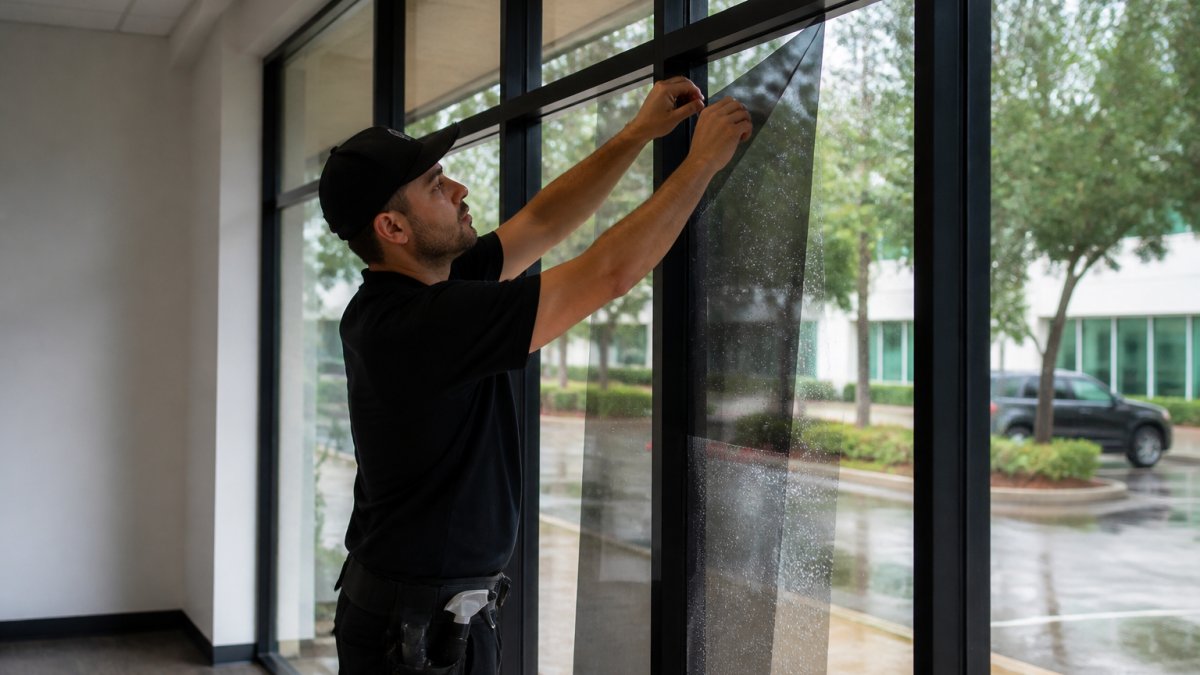
Commercial window film energy savings come from rejecting solar heat before it enters the space, which lowers cooling demand at the point of the problem instead of compensating for it downstream.
Coral Tint uses precision-cut films to reduce heat and glare, block UV rays, and improve privacy. For owners comparing options on large glass areas, our guide to the best window film for glare reduction covers film selection by performance need.
Reflective vs. Neutral Film for Storefronts
Reflective film rejects more solar energy but changes the building's exterior appearance and can read as a mirror during the day. Neutral film keeps a more natural look and still cuts heat and glare, which matters for retail frontage where visibility drives sales.
If your storefront is the product display, neutral usually wins. Our guide on how to choose the best window tint for Florida heat walks through that trade-off for hot-climate storefronts.
Benchmarking, Measurement and Verification, and What to Ignore
Benchmarking tells you where you stand. Measurement and verification tells you whether the commercial energy efficiency upgrade worked. Most owners do the first and skip the second, which is why so many efficiency projects cannot defend their savings a year later. This section lays out a practical M&V process for making claimed savings credible.
Step 1: Establish a Baseline You Can Defend
The ENERGY STAR Portfolio Manager benchmarking tool provides a no-cost way to compare a building's energy use against similar buildings, which is a sensible starting line. It is not a monitoring or control system, and it will not tell you which measure paid off.
A defensible baseline needs three things:
- Twelve months of utility data at the meter level, not a single bill. Seasonal variation is the whole point.
- A documented operating profile, hours, occupancy, and any known anomalies (a chiller outage, a tenant fit-out) that would distort the baseline.
- A stated adjustment method for weather and occupancy, agreed before installation. If the method changes after the fact, the savings number is not credible.
Step 2: Submeter What You Are Claiming
Whole-building utility data cannot isolate a single measure. Submetering the affected circuit, lighting panel, RTU, or cooling plant, gives you a direct before/after comparison that survives scrutiny. For measures that interact (lighting that also cuts cooling load), submeter both the measure and the interacting system so you can report the net effect rather than double-counting.
Step 3: Normalize for Weather
Weather normalization adjusts measured consumption to what it would have been under baseline conditions. Degree-day methods are the common approach: compare post-project consumption against the baseline model at the same heating and cooling degree days. Without normalization, a mild summer looks like a successful project and a hot one looks like a failure.
Step 4: Verify After the Project
Post-project verification should follow a documented protocol, the U.S. Department of Energy's Federal Energy Management Program M&V guidance describes the standard options (retrofit isolation, whole-building, and calibrated simulation) that most commercial projects map onto. Pick the option before you buy, not after.
What to Ignore
- Nameplate savings claims. A percentage on a spec sheet is not a building-specific estimate.
- Single-bill comparisons. One month before and one month after proves nothing about a measure's performance.
- Benchmark scores presented as savings. A Portfolio Manager score is a peer comparison, not a measurement of your project.
Tie every measure in your roadmap to one of these verification methods, and the savings conversation shifts from assertion to evidence.
Sequencing the Work: A Prioritized Roadmap and Payback Order
Sequence by payback and by load reduction, not by vendor enthusiasm. Here is the order we would run on a typical commercial building:
| Step | Measure | Why It Comes Here | Verification Method |
|---|---|---|---|
| 1 | Energy audit and benchmarking | Establishes baseline and peer comparison | Portfolio Manager score |
| 2 | Lighting and controls | Fast payback, cuts internal heat gain | Sub-metered lighting circuit |
| 3 | Window film on exposed glass | Reduces solar load before HVAC sizing | Pre/post cooling demand comparison |
| 4 | HVAC controls and commissioning | Captures load already removed | Trend logs from BAS |
| 5 | Equipment replacement | Capital-heavy, do it last and right-sized | Utility bill normalization |
Film lifespan affects how you weigh step 3 against later steps. Our guide on how long window tinting lasts covers film lifespan so you can judge long-term payback when prioritizing upgrades. Watch out: replacing HVAC before reducing solar load routinely oversizes equipment you then pay to run for a decade.
Request a Commercial Window Film Assessment
The cheapest energy is the load you never create. If your building runs hot on the afternoon side and the audit points at envelope gain, film is the measure to price first.
Coral Tint has served South Florida since 1995 as a family-owned and locally operated business, with local and government project experience, and a 4.7 rating across 138 reviews. We handle commercial, residential, automotive, and marine work with precision-cut films. If you want evidence that film moves the bill before committing to the premise, read how window tinting reduces electric bills.
Request a quote from Coral Tint for your building. Our guide on booking professional window tinting explains how to move from planning to action.
Frequently Asked Questions
What are the most effective ways to improve energy efficiency in a commercial building?
The order that usually works: benchmark consumption first, then fix the cheapest loads. Lighting retrofits and controls deliver fast payback because lighting is a direct electricity load and also adds heat. HVAC tuning and scheduling come next. Reducing solar gain through glass, including commercial window film energy savings, lowers the cooling load the HVAC system has to fight. The U.S. Department of Energy's Better Buildings program and ENERGY STAR Portfolio Manager offer free benchmarking resources to establish a baseline before you spend.
How can window film improve commercial building energy efficiency?
Film changes how much solar heat and UV radiation pass through existing glass, so the cooling system runs less during peak afternoon hours. It also cuts glare on screens and slows interior fading. Because it retrofits the glass you already have, there is no window replacement and no structural work. Actual commercial window film energy savings depend on glass type, orientation, square footage, and climate, so ask for a film-to-glass assessment before committing to a specification.
What is the difference between reflective and neutral window film for storefronts?
Reflective film has a mirrored surface that bounces a large share of solar energy away, which gives the strongest heat rejection but changes the building's exterior appearance and can look darker from outside at night. Neutral film rejects heat with a low-visibility tint, so displays stay readable and the facade stays close to its original look. Retail storefronts with merchandise visible from the street usually lean neutral; back-of-house or west-facing glass with heavy heat gain often suits reflective.
How do you conduct an energy audit for a commercial building?
A walk-through audit starts with 12 months of utility bills to establish the baseline, then a room-by-room survey of lighting wattage, HVAC schedules and setpoints, envelope condition, and plug loads. Better audits add sub-metering or data logging on major circuits. The output should be a list of measures with estimated savings, installed cost, and simple payback, ranked. Without that ranked list, an audit is just a report; the ranking is what turns it into a plan.
How do you measure energy savings after a building efficiency upgrade?
Use measurement and verification: record a baseline period of consumption, normalize for weather and occupancy, install the upgrade, then compare a matched post-installation period against that normalized baseline. Whole-building utility data works for large measures; spot measurement with data loggers works better for single systems. Without normalization, a mild month can make any upgrade look successful. Set the baseline before work begins, because reconstructing it afterward is guesswork.
The challenge is not knowing that efficiency matters. It is knowing which measure to fund first and how you will prove it worked. Coral Tint brings precision-cut film installation, a nationwide lifetime warranty, and three decades of local commercial project experience to that decision. Get started with Coral Tint and request a quote for a commercial window film assessment.