 blog
9 Window Film vs Heavy Curtains Factors for Your Home
Coral Tint factors 954-752-5672
Last Updated: November 5, 2026
Quick Summary
Window film and heavy curtains solve overlapping problems in different ways. Film bonds to the glass and cuts heat and glare before light enters the room, while curtains hang inside and block light after it has already come through. Many homes benefit from using both together.
- Window film works on the glass, cutting heat and glare before they enter the room.
- Heavy curtains work inside the room, blocking light and adding insulation.
- Many window films reduce glare, UV, or heat rather than fully darkening a room.
- Choose blackout curtains for bedrooms, nurseries, and home theaters.
- Curtains handle nighttime privacy more reliably because they physically block the view.
Table of Contents
- Window Film vs Heavy Curtains: The Core Difference
- Heat Reduction and Solar Heat Gain Compared
- Light Control, Blackout Performance and Blackout Curtains
- Privacy Day and Night: Privacy Window Film or Curtains
- Window Film vs Heavy Curtains Cost and Long-Term Value
- Reflective Window Film, Glass Compatibility and Maintenance
- Choosing Your Next Step for a Cooler, Private Home
- Frequently Asked Questions
Window Film vs Heavy Curtains: The Core Difference
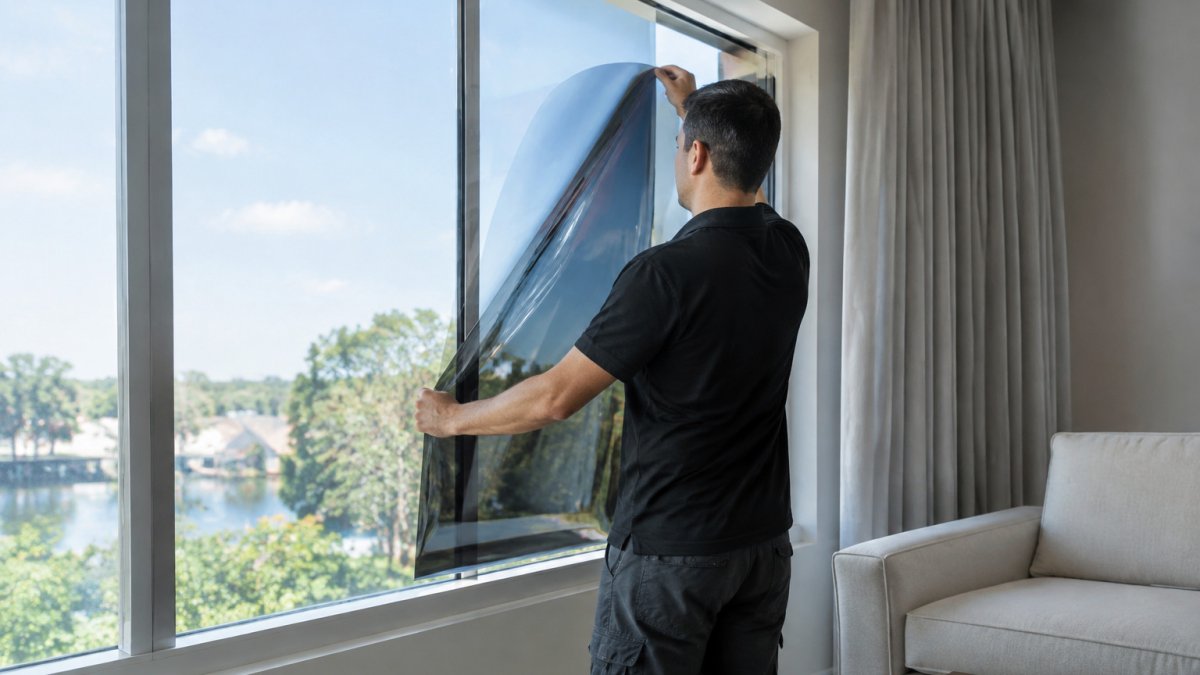
Window film and heavy curtains solve overlapping problems in different ways. Film bonds to the glass itself and works before light ever reaches your room. Curtains hang inside the room and work after the light has already come through. That single difference shapes every comparison that follows.
Homeowners in Coral Springs often weigh these two options. The core question is whether you are trying to stop heat at the glass, or block light and views inside the room. The answer changes which option makes sense.
Meridian Window Tint's comparison suggests curtains provide the most complete privacy, while film balances light and visibility control Meridian Window Tint privacy window film vs curtains comparison. The result doesn't specify conditions such as nighttime lighting, so treat that as a starting point rather than a rule.
The short version:
- Window film works on the glass. It cuts heat and glare before they enter.
- Heavy curtains work in the room. They block light, add insulation, and give the most complete privacy.
- Both together often outperform either option alone.
Heat Reduction and Solar Heat Gain Compared
Solar heat gain is the warmth sunlight delivers through your windows. How much of that energy enters is described by the solar heat gain coefficient (SHGC), a number between 0 and 1, lower means less heat admitted. Visible light transmission (VLT) describes how much daylight passes through, and UV rejection describes how much of the ultraviolet band is screened out.

Film tackles heat at the source. A spectrally selective film is engineered to reject a large share of the infrared and UV bands while keeping a useful amount of visible light, so the glass itself admits less total solar energy before it ever reaches the room. Heavy curtains work after the fact: the glass absorbs and re-radiates heat inward, and the curtain intercepts some of that radiant flow and the convected air behind it. A lined, floor-length curtain drawn tight to the wall performs better than an unlined panel with a gap at the top and sides, because the gaps let hot air spill around the fabric.
Fabric and construction matter more than most shoppers expect. Unlined decorative curtains offer modest heat control. Blackout curtains with a tight weave and a foam or acrylic backing add a reflective and insulating layer. Thermal-backed curtains go further by pairing a blackout face with a separate lining that reduces radiant transfer. In every case, fit decides real-world performance: a curtain that covers the window plus several inches on each side and reaches the floor, hung on a return or ceiling track, traps a pocket of still air that slows heat movement. A curtain that stops at the sill or leaves a wide side gap leaks most of the benefit. Because the still-air pocket depends on a close fit as well as the material, comparing curtain fabric types such as linen and cotton can help you choose a fabric that suits a sunny room.
Climate changes the calculus. In hot, sunny climates, west- and south-facing glass drives afternoon cooling load, and film's ability to cut SHGC at the pane is the higher-leverage move. Heavy curtains can add a layer of insulation over the glass at night, when there is no solar gain to preserve.
A word on measurement. Rather than trusting broad claims, compare products on published SHGC, VLT, and UV rejection figures, and take before-and-after temperature readings on the same window at the same time of day. A simple infrared thermometer aimed at the interior glass surface and at the room side of the curtain will show which layer is doing the work.
Light Control, Blackout Performance and Blackout Curtains
This is where the two options split most sharply. Many window films reduce glare, UV, or heat rather than fully darkening a room. That matters when your main goal is a dark bedroom or media room.
Deconovo points out that many window films reduce glare, UV, or heat rather than fully darkening a room Deconovo blackout curtains vs window film guide. If full darkness is the goal, blackout curtains usually do the job better.
Here's how to decide:
- Choose blackout curtains for bedrooms, nurseries, and home theaters.
- Choose film when you want to keep the view and natural daylight while cutting glare.
- Combine both for a bedroom that stays cool and dark.
Want to see how light control works in practice? Our guide will window tint make a room dark? 6 facts to know explains how much light film really blocks.
Privacy Day and Night: Privacy Window Film or Curtains
Privacy behaves differently in daylight and at night. During the day, privacy film lets you see out while blocking the view in. At night, the lighting flips. A lit room can be visible from outside even with film in place.
Curtains handle nighttime privacy more reliably because they physically block the view. Film is better for keeping daytime privacy while preserving outward views and natural light.
For a deeper look at how each option performs across the full day, see our window tinting for privacy at home guide.
Window Film vs Heavy Curtains Cost and Long-Term Value
Upfront price is the easy comparison and the least useful one. The better question is total cost of ownership over a defined period, say ten years, which means adding purchase, installation, replacement, energy savings, and maintenance for each option on the same windows.
On the film side, cost scales with square footage, film type, and installation complexity. Pricing depends on quantity, the film selected, and installation details, so request a quote from Coral Tint for current pricing. Film is installed on existing glass with no hardware to buy, and maintenance is minimal.
On the curtain side, the fabric is only part of the system, since rods, brackets, and hanging add to the total. Curtain costs are generally a matter of the specific fabric and fit you choose.
Energy savings are where the two diverge. Film's savings show up as reduced cooling load on sun-facing glass, and the payback period depends on your utility rate, the window's orientation, and how much of the day the glass is exposed. Curtains act after the heat is already inside, so they contribute less to cooling savings.
A workable method: list every window, note orientation and glazing type, estimate film cost per square foot and curtain cost per window including hardware, then subtract projected annual energy savings from each. Divide the net upfront cost by annual savings to get a rough payback in years. Most practitioners find film pays back faster on west- and south-facing glass in hot climates, while curtains pay back mainly through comfort and reduced winter heat loss rather than utility savings. Watch out: quoting a payback figure without your actual utility rate and window orientation is guesswork, so use your own bills rather than a generic estimate. For a closer look at where film savings come from, our article on 5 ways window tinting reduces electric bills for homeowners breaks down the line items.
Reflective Window Film, Glass Compatibility and Maintenance
Not every window suits every film, so check compatibility before you buy.
Good maintenance extends film life. A few habits help:
- Clean with a soft cloth and mild, ammonia-free cleaner.
- Avoid sharp tools near the film edges.
- Check edges regularly for lifting or bubbling.
- Address small problems early before they spread.
Heavy curtains need different care. Wash or dry-clean them as the label directs, and check the lining for wear. For more on keeping film in good shape, read our film care steps that prevent peeling.
Choosing Your Next Step for a Cooler, Private Home
Pick film if your main problems are heat, glare, and daytime privacy. Pick heavy curtains if you need blackout darkness and nighttime privacy. Many homes benefit from both.
Coral Tint has served South Florida homeowners since 1995. Our family-owned team installs precision-cut film for homes, vehicles, and commercial spaces. We also offer a nationwide lifetime warranty on our work. Request a quote today and we'll help you choose the right approach for your windows. If you're ready to move forward, you can book professional window tinting with our team.
Frequently Asked Questions
Do heavy drapes keep the cold out?
Heavy drapes add an insulating layer that can reduce heat transfer through a window, especially when they are fully closed and fit closely to the wall or frame. In South Florida the bigger concern is usually heat gain rather than cold, so drapes help most when they are closed during the hottest part of the day. Their effect depends on lining, fabric weight and fit, so a thick, lined curtain that sits tight to the window performs noticeably better than a sheer or loosely hung panel. Pair them with window film if you want the sun's heat reduced before it reaches the fabric.
Can privacy window film replace curtains?
Privacy window film can replace curtains for daytime privacy, since it obscures views into a room while still letting light in. It does not usually provide the same nighttime privacy, because interior lights make the room visible from outside, and many films are less effective at night. If you need full darkness for sleeping or media viewing, curtains are still the more reliable choice. Many homeowners use film for everyday privacy and keep a few curtains for bedrooms.
Can you use window film and heavy curtains together?
Yes. Window film handles heat reduction and UV protection on the glass, while curtains add darkness, insulation and softness to the room. The combination works well in rooms that get intense afternoon sun, such as west-facing living rooms or bedrooms. Film applied to the glass also protects the fabric from fading, which extends the life of the curtains.
How much does window film cost compared with heavy curtains?
Pricing depends on window size, the film selected, installation complexity and the curtain fabric and lining you choose, so no single figure applies to every home. Coral Tint provides current pricing and free quotes based on your specific windows, and you can request one through the company website. When comparing options, look at upfront cost, expected lifespan and whether the solution also reduces cooling costs, since that long-term savings can change which option is more economical.